UTSURUMADE
You take it now.You see it later.
A camera that shows you nothing until the film is developed.
A frame cannot be seen when you take it. You send the roll to develop, and only once the wait is over do you learn what was on it.
Coming soon to the App Store
iPhone and iPadiOS 16.4 or laterFree, with ads
undevelopeddeveloped
01
A frame got lighter
Dozens of frames a day, and burst on top of that.
And with them went the moment between raising the camera and pressing.
You shoot, and shoot, and the frames pile up unlooked-at.
It is not so much that photographs got lighter as that taking them did. This app makes that one thing heavy again.
02
Why you are not shown the photograph
No judging on the spot.
The viewfinder is small and no thumbnail appears after the shutter. There is simply no moment in which to grade the frame you have just taken.
No burst.
A second shot needs a one-second gap. Losing two frames to one mis-press is the saddest way to lose them.
No second take.
You can throw away a whole roll, never a single frame. So the moment between raising the camera and pressing gets a little longer.
03
How it works
Shoot blind, wait, then see. Four things, that is all.
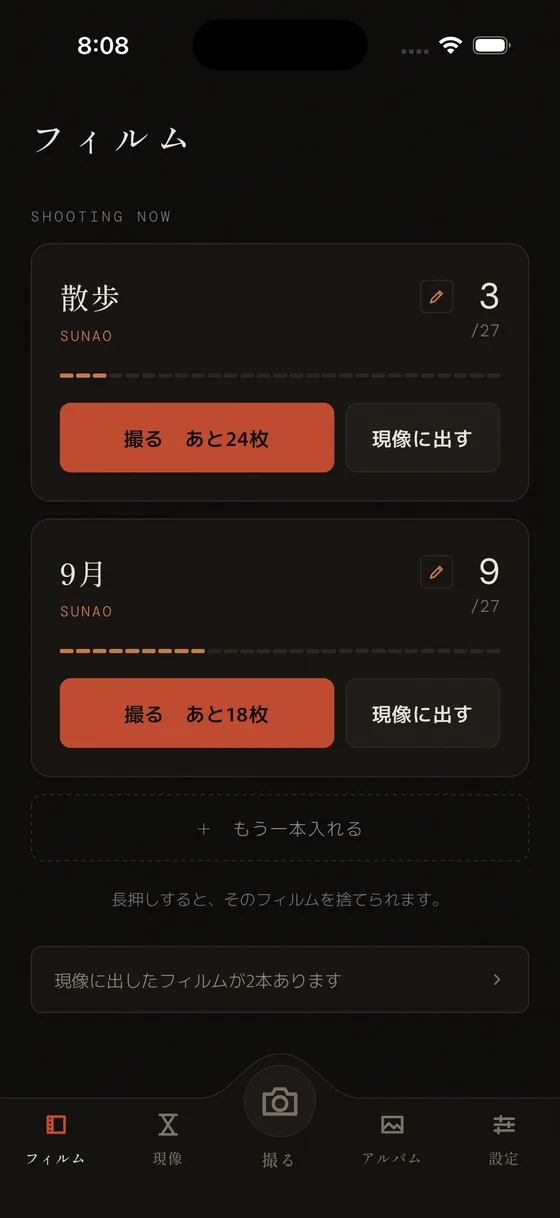
- 01
Load a roll
Choose a name and a look. You can hold up to 3 undeveloped rolls at once.
- 02
Shoot
You cannot see what you shot. The viewfinder is small on purpose too — so you do not judge a frame on the spot.
- 03
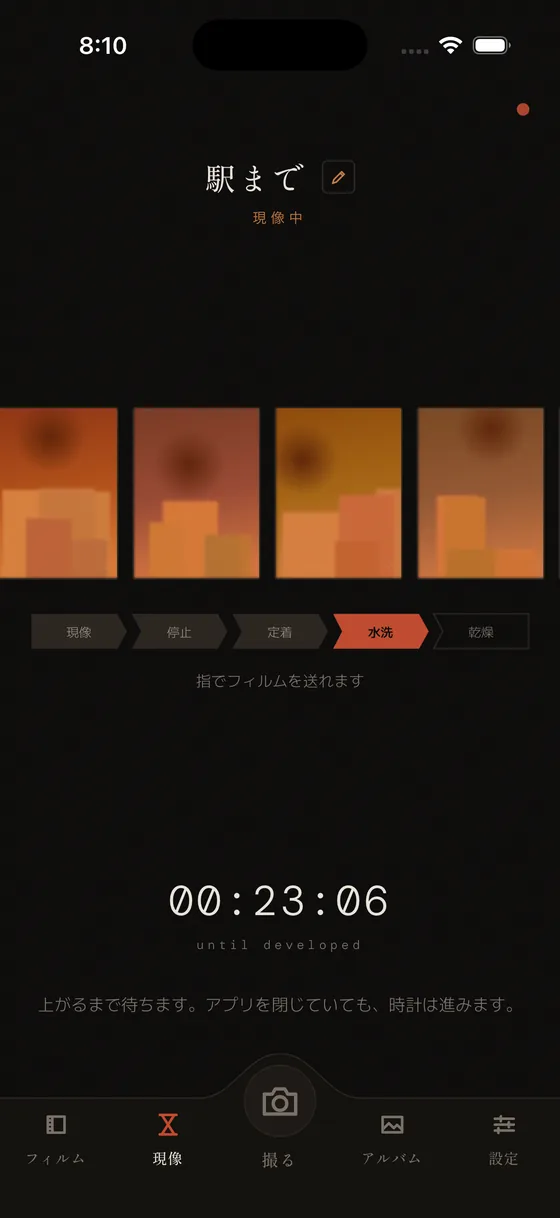
Send it to develop
The clock starts the moment you press “Send to develop”. You wait as long as the number of frames asks for. You can send a roll before finishing it.
- 04
See it in the album
Open a finished roll and the frames surface one by one. This is the first time you see them.
04
The wait is set by the frames
Drag it. You wait as long as the number of frames asks for.
Frames shot
24frames
Time to develop
27 min
68.3 sec per frame
Frames 1–10 take 80 sec each, 11–25 take 60, and 26 onward take 50 — a full roll of 27 comes to 30 minutes. The more you shoot, the less each frame costs. Mixing the chemistry takes the same work however many frames go in — the same arithmetic a real lab runs on.
The clock starts the moment you press “Send to develop”. Finishing a roll does not start it. Close the app while you wait and you will still hear when it is done.
05
And then, at last, you see
Open a roll that has finished waiting and the frames surface, one by one.
By then you have usually forgotten what you shot. The light of that day, and why you pressed just there, come back a frame at a time.
There is no grading left to do. Because there was no moment in which to judge, what remains is only what was there.
06
Four looks
Chosen when you load a roll, and fixed from then on.
SUNAO
close to what you saw
Free
Grain and a faint bloom around the light — that is all this one adds. Color and brightness stay close to what your eyes saw, so the look never takes over the subject. Start here when you have not decided what to shoot.
HINATA
deep yellow, for late light
Plus
Pushed toward yellow, with a wide bloom around strong light; shadows keep a violet cast. It photographs the light itself, so on a cloudy day or indoors there is little for it to work with.
YOI
night lamps, coarse grain
Plus
Blacks are lifted rather than closed, and shadows stay blue. The grain is the coarsest of the four, and lamps bloom widely. It is built for dark places; in daylight it only looks flat.
SUMI
light and shadow only
Plus
Color is dropped and the distance between light and dark is widened. Anything that worked because of its color stops working; shape and shadow are what is left.
The number after the name is film speed, as on a real roll: the higher it is, the darker a place you can shoot in, and the coarser the grain. In this app the grain is matched to that number.
The look names belong to this app. No real-world brand is borrowed.
07
This app has no server
Neither your photographs nor the developed versions reach the developer. No usage analytics and no crash reports are collected.
A photograph leaves your device only when you save it to your camera roll or share it.
An undeveloped frame sits on your device, seen by nobody yet.
08
About the advertising
The only ad is a single rewarded video, and it never appears unless you press it. Watching one gives you another roll of film — it does not bring the develop time forward. Nothing shortens the wait: the waiting is what this app is, so making it purchasable would leave only the shape of it. Your first roll needs no video. Your photographs are never used for advertising.
An edition without ads (UTSURUMADE Plus) is on its way, as a separate app.
09
Questions
The things people trip over most.
My photos are nowhere to be found
That is how it works. A photo cannot be seen until you send the roll to develop and the wait is over. There is no thumbnail on the shooting screen either, for the same reason: so you do not judge a frame on the spot.
How is the develop time decided?
By how many frames you shot. Frames 1–10 take 80 sec each, 11–25 take 60, and 26 onward take 50. The more you shoot, the less each frame costs.
So 10 frames take 13 min, 20 frames 23 min, and a full roll of 27 takes 30 min.
The clock starts the moment you press “Send to develop”. Finishing a roll does not start it.
Do I have to finish a roll before developing it?
You can send it whenever you like. The remaining frames can no longer be shot, so we show you how many you are giving up before you send.
What happens to my photos if I delete the app?
They go with it, undeveloped ones included, and cannot be recovered. Anything you want to keep should be developed and saved to your camera roll.
Are my photos sent anywhere?
No. This app has no server. A photo leaves your device only when you save or share it yourself.
You take it now. You see it later.
Load one roll. By the time it is up, you will have forgotten what you shot.
Coming soon to the App Store
iPhone and iPadiOS 16.4 or laterFree, with ads